

The contractor is scheduled to arrive at 8 a.m. and you are not sure what is about to happen in your house. Will they start immediately or spend the morning organizing? Are there things you should have ready? Is it normal that they have not said much since the contract was signed? And honestly, how much dust are you about to be living with?
Day one of a drywall project has a predictable sequence that most homeowners have never witnessed. Understanding what should happen, and what the contractor is doing and why, lets you confirm the job is going well and catch any early signs that it is not.
Before Day One: What You Need to Have Ready
What should a homeowner do before the drywall crew arrives?
The most common day-one delay is not caused by the contractor. It is caused by conditions in the home that were not addressed before the crew arrived. Clearing the work area ahead of time prevents setup time from eating into billable labor hours you are paying for.
Before the crew arrives, confirm the following are complete:
- All furniture and stored items removed from work areas. This includes items in adjacent rooms that may be affected by dust. Drywall installation and finishing produce significant fine gypsum dust that travels through HVAC systems and settles on surfaces well beyond the immediate work zone.
- Floor coverings protected or removed. Finished hardwood, tile, and carpet in and adjacent to the work area should be protected with drop cloths or builder paper. A professional crew will typically bring their own protection materials, but confirming this in advance prevents assumptions from both sides.
- All rough-in inspections passed and documented. Drywall installation cannot legally begin in most jurisdictions until framing, electrical, plumbing, and HVAC rough-in inspections have been signed off by the building department. Have these approval documents accessible when the crew arrives.
- Staging and access route confirmed. Know which entrance the crew will use for material delivery, where cut-off waste will be staged before disposal, and whether any areas need to be temporarily closed off to protect finished surfaces.
- Temperature and humidity controlled. Joint compound requires indoor temperatures between 55 and 75 degrees Fahrenheit and relative humidity around 50 percent to cure correctly. If the work area does not yet have climate control, discuss this with the contractor before day one, not after the first coat fails to dry.
Most experienced drywall crews work efficiently on a clear site and lose time on a cluttered one. Every 30 minutes of setup time that could have been avoided is 30 minutes of labor cost without progress. Preparing the space is one of the few ways homeowners directly affect the total labor cost of a project.
The Day-One Sequence: What Actually Happens Hour by Hour
What does a drywall crew do on the first day of a project?
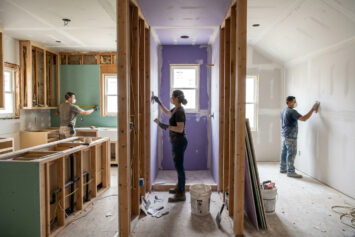
Day one of a drywall installation project follows a consistent sequence for most professional crews. The specific timing varies by project size and crew, but the activities are predictable.
| Time | Activity | What It Means for the Homeowner |
|---|---|---|
| First 30–60 minutes | Materials delivery, site setup, and framing walkthrough | Panels are staged near the work area; crew lead walks the framing before anything is hung |
| 60–90 minutes in | Ceiling work begins (if ceilings are in scope) | Ceilings go up before walls; scaffolding or lift equipment is set up as needed |
| Mid-morning | Hanging in progress; cut pieces made at staging area | Audible cutting noise is normal; expect a consistent rhythm of screw gun and scoring |
| Midday | Ceiling work complete in primary rooms; wall hanging begins | On a standard two- or three-room scope, a professional crew typically completes hanging and starts wall work by midday |
| End of day | Hanging phase complete or near complete; site cleanup of offcuts | No compound applied on day one; taping begins on day two after hanging is finished and inspected |
Day one is almost entirely the hanging phase. Joint compound does not go on until hanging is complete. If a contractor applies tape and compound on day one while hanging is still in progress in other rooms, they are either working on a small single-room scope or rushing the sequence in a way that can produce problems at seams that are not fully supported.
The Framing Walkthrough: The First Thing That Should Happen
Why does a professional contractor walk the framing before hanging any drywall?
Before the first panel goes up, a professional crew lead walks the framing to check for conditions that will affect the installation and finish quality. This is one of the clearest indicators of an experienced crew versus a crew that moves fast without thinking ahead.
During this walkthrough, the contractor checks for:
- Bowed, twisted, or out-of-plane studs that will prevent panels from lying flat against the framing. A stud that is bowed more than 1/4 inch from the plane of the wall will telegraph through the finished drywall surface regardless of how many finish coats are applied. Catching this before hanging allows correction at framing cost rather than finish cost.
- Missing blocking for wall-mounted items such as TV mounts, grab bars, large mirrors, or built-in shelving brackets. Adding blocking after drywall is installed requires cutting into finished walls. The pre-hang walkthrough is the last cost-effective opportunity to install it.
- Electrical boxes and low-voltage rough-in locations that will require precise panel cuts. A contractor who marks these before cutting panels produces cleaner, more accurate openings than one who discovers them as they go.
- Any areas where moisture-resistant or fire-rated board is required but has not yet been identified or staged separately. A bathroom wall that receives standard board instead of moisture-resistant board because neither the homeowner nor the crew confirmed it before hanging is a correction that costs more than the board upgrade would have.
Most professional drywall crews include this walkthrough as part of their standard process before starting any project. If a crew arrives and immediately begins cutting panels without walking the space first, that is a reasonable point to pause and request the walkthrough before proceeding.
Material Delivery and Acclimation: A Detail That Affects Finish Quality
Why do drywall panels need to be in the work area before installation?
Gypsum board responds to temperature and humidity. Panels delivered from a cold truck or outdoor storage directly into a warm, climate-controlled home will experience dimensional changes as they adjust to indoor conditions. Installing panels before they have acclimated to the indoor environment can produce gaps at seams, fastener pops, or surface cracking as the material moves after installation.
Professional practice is to stage materials in the work area at least a few hours before hanging begins, allowing panels to reach equilibrium with the interior environment. On day one, this means panels should arrive early in the morning and be staged in the rooms where they will be installed before the crew begins hanging, not carried directly from the delivery truck to the wall.
This is a subtle quality indicator that most homeowners would not notice, but it is one that experienced contractors build into their process. A delivery that arrives simultaneously with the crew beginning work, with panels going straight from truck to wall, is a sign that the project was not planned with this step in mind.
Living in the Home During Installation: What to Prepare For
How disruptive is having a drywall crew working in your home?
Drywall installation is one of the dustier trades in residential construction. Fine gypsum dust generated by cutting and sanding is very light and travels farther than most homeowners expect. It moves through HVAC systems, settles on horizontal surfaces, and finds its way into adjacent rooms through gaps around doors and vents.
If you are living in the home during the project, prepare the non-work areas before day one by:
- Closing HVAC vents in the work area if possible, or consulting with the contractor about temporary plastic duct covers during cutting phases
- Sealing the gap under any door between the work zone and occupied living areas with a draft excluder or temporary plastic barrier
- Covering electronics, bedding, and clothing in nearby rooms, since gypsum dust is fine enough to settle through most loose closures
- Planning to run air purifiers with HEPA filters in occupied areas during and after the cutting and sanding phases
The most significant dust occurs during two phases: cutting panels on day one and sanding during the finish phase near the end of the project. These are the days when occupants with respiratory sensitivities may want to minimize time in the home, and when extra protection of nearby surfaces is most worthwhile.
The Scope Confirmation Conversation: What to Go Over Before Work Starts
What should a homeowner confirm with the contractor on the morning of day one?
Day one is the last practical opportunity to confirm scope details before material is cut and fastened and changes become costly. A five-minute conversation at the start of the day prevents the most common mid-project disputes.
Confirm the following verbally with the crew lead before any work begins, and cross-reference against the written contract:
- Which rooms and surfaces are in scope, and which are not
- The finish level specified for each room: Level 3, 4, or 5
- Whether texture is included, and if so, which type in which rooms
- Which board type is specified for bathrooms, garages, and any other specialty locations
- Where waste will be staged and how debris removal will be handled
- The approximate schedule for subsequent phases, including when taping will begin and when the project is expected to be paint-ready
Most drywall pros welcome this conversation because it confirms alignment before the first cut and prevents misunderstandings that create friction later in the project. A crew lead who is impatient with scope confirmation questions at the start of day one is giving you early information about how the rest of the project will be managed.
What Quality Looks Like on Day One
How can a homeowner recognize whether hanging work is being done correctly?
You do not need drywall expertise to notice the indicators of professional work as it happens. As the crew hangs panels, observe these specific quality indicators:
- Panels are tight against the framing with no visible gaps at edges or between sheets at seams
- Fasteners are set slightly below the panel surface, creating a small dimple, not breaking the paper face of the board
- Ceiling panels go up before wall panels where both are in scope, because ceiling installation is easier before walls are in place and because wall panels support the ceiling edge
- Cuts around electrical boxes are clean and close, leaving minimal gap between the panel edge and the box
- Crew members are using the right tools: screw guns set to proper depth, not hand-driving screws or using nails on new construction
None of these require you to stand over the crew. A brief walkthrough at midday and at the end of day one gives you enough visibility to confirm the work is progressing correctly without being disruptive to the crew’s pace.
Find a Contractor Who Makes Day One Run Smoothly
A professional drywall contractor arrives prepared, walks the framing before touching a panel, confirms scope with you before starting, and runs the day in a way that keeps the project on schedule and on budget. That level of organization on day one is a reliable predictor of how the rest of the project will go.
DrywallProCenter.com connects homeowners with verified drywall professionals across the country. Search by zip code, compare contractor profiles, and request quotes from multiple pros in one place. Whether you are planning your first drywall project or replacing a contractor mid-job, finding the right crew starts here.
Recent Drywall Articles
- Drywall Cost by Room: Kitchen, Bathroom, Bedroom Compared
 You are trying to budget for a renovation and you need a rough number for each room. The challenge is that drywall pricing is not consistent across room types. A … Read more
 - What Insurance Should My Drywall Contractor Have?You asked a contractor whether they are insured and they said yes. That answer, on its own, protects you almost not at all. There are multiple types of insurance a … Read more
- How to Get Multiple Drywall Bids and Actually Compare ThemYou have three quotes and the numbers are all over the place. One comes in at $1,900, one at $2,700, and one at $3,400. The instinct is to assume the … Read more
- What to Expect on Day One When Your Drywall Contractor ArrivesThe contractor is scheduled to arrive at 8 a.m. and you are not sure what is about to happen in your house. Will they start immediately or spend the morning … Read more
- Red Flags to Watch for When Hiring a Drywall ContractorYou have a few contractor quotes in hand and one of them is significantly cheaper than the others. Or a contractor showed up unsolicited after the storm last week and … Read more
- How to Read a Drywall Contractor’s Quote Without Getting BurnedYou have three quotes in hand and they are not close to each other. One comes in at $1,800, one at $2,600, and one at $3,100 for what appears to … Read more




This article was drafted with the assistance of AI and has been reviewed and edited by our editorial team for accuracy and quality.