

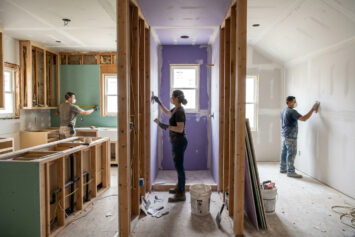
You are planning a bathroom remodel in a home built in 1968. Or patching a crack in a living room wall that has been there since you moved in. Or simply sanding down a joint before repainting. None of these seem like major projects. In a pre-1980 home, all of them can disturb materials that may contain asbestos, and once those materials are disturbed, the exposure risk is immediate and irreversible.
Understanding where asbestos actually lives in older drywall, what actions release fibers into the air, and what the testing and removal process involves gives you the information to protect your household before anyone picks up a tool.
Where Asbestos Actually Hides in Older Drywall: The Distinction Most Homeowners Miss
Is asbestos in the drywall sheet itself or somewhere else?
This is the most important and most commonly misunderstood fact about asbestos and drywall: the risk is almost never in the drywall board itself. Gypsum board, the core material in standard drywall, rarely contained asbestos. The materials that did contain it are the ones you cannot see without getting close, the finishing products applied at the seams and surfaces during original construction.
The primary asbestos-containing materials associated with drywall in pre-1980 homes are:
- Joint compound (drywall mud): Used to cover seams between panels, fill screw holes, and create smooth surfaces. Studies have found that up to 70 percent of pre-1980 joint compound samples tested in North America contained asbestos, with some products containing 3 to 6 percent asbestos by weight. This was the most common application of asbestos in residential drywall finishing.
- Joint tape: The paper or mesh tape embedded in joint compound at seams. Some tape products used before the late 1970s also contained asbestos fibers mixed into the material.
- Texture coatings: Spray-on and hand-applied textured finishes applied to walls and ceilings, including the compound used to create orange peel, knockdown, and popcorn ceiling textures. These materials frequently contained asbestos as a strengthening and fire-retardant additive.
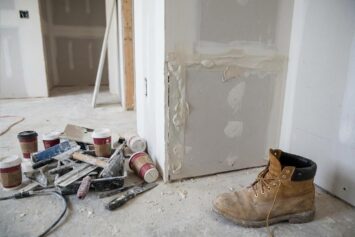
- Patching and spackling compounds: Products used for small repairs and touch-ups before 1977 commonly contained asbestos. A minor crack repair done in 1972 on a 1965 home may have introduced asbestos even if the original finishing compound did not.
The practical implication is significant. You can have a home where the drywall sheets were installed asbestos-free but where the joint compound, texture coat, or patch repairs contain asbestos. The only way to know which materials in your specific home contain asbestos is to test them. Visual inspection cannot identify the presence of asbestos fibers in any material, regardless of age, color, or condition.
The 1977 Regulatory Cutoff: Why This Date Matters
When did asbestos stop being used in drywall finishing materials?
The U.S. Consumer Product Safety Commission banned asbestos from patching and spackling compounds in 1977, which effectively removed it from most new joint compound products sold after that date. However, existing inventory continued to be sold and used for several years after the ban, and asbestos remained in some texture products and specialty applications into the early 1980s. The EPA enacted further restrictions beginning in 1973 and continuing through its partial ban in 1989, but the phase-out was not immediate or uniform across all product categories.
The practical guidance for homeowners: any home built or substantially renovated before 1985 should be treated as potentially containing asbestos in drywall finishing materials until tested. Homes built between 1940 and 1977 carry the highest probability, as this was the period of peak asbestos use in construction. Homes built in the early 1980s carry lower but non-zero risk, particularly if renovation or repair work was done using materials purchased from existing inventory before the transition to asbestos-free products was complete across the supply chain.
The EPA finalized a comprehensive chrysotile asbestos ban in March 2024, covering remaining uses in chlor-alkali manufacturing. New residential construction has not used asbestos in standard drywall finishing materials for decades, but this history is irrelevant to the materials already installed in older homes across the country.
The Actions That Release Asbestos Fibers: What Triggers Risk
When does asbestos in drywall become dangerous?
This is the question that changes how you should approach any work in an older home, and the answer is specific. Asbestos in joint compound, texture coatings, and patching materials is generally classified as non-friable when it is intact, meaning it is bonded tightly enough in the material that fibers do not escape under normal conditions. A wall with asbestos-containing joint compound that is undisturbed behind a layer of paint does not pose an active daily exposure risk in most circumstances.
The risk becomes acute the moment those materials are mechanically disturbed. The following actions can release asbestos fibers from intact joint compound or texture coatings into the air:
| Action | Risk Level | Why It Matters |
|---|---|---|
| Dry sanding joint compound or texture | High | Generates fine airborne dust directly from asbestos-containing material; highest fiber release of any common renovation activity |
| Cutting or scoring drywall through finished surfaces | High | Cutting through joint compound at seams releases fibers into the immediate work area |
| Drilling through finished walls | Moderate to high | Drill passes through surface compound and texture; dust generated at point of entry contains fibers from finishing materials |
| Removing drywall panels during renovation | High | Breaking panels apart disturbs compound at seams and edges throughout the removal process |
| Scraping texture from ceilings or walls | Very high | Directly removes and disturbs the most commonly asbestos-containing surface material in older homes |
| Patching a crack by sanding the area smooth | Moderate to high | Sanding existing compound before applying new material is one of the most common inadvertent exposure routes |
| Painting over undisturbed, intact surfaces | Very low | Applying paint to an intact surface does not disturb the underlying material; risk is minimal without mechanical action |
The critical takeaway is that seemingly minor repairs, a crack patch, a nail hole fill, a ceiling texture scrape, carry the same fiber release risk as major renovation work if the underlying material contains asbestos. Scope of the renovation is not a reliable proxy for risk. The material composition determines the risk, and that requires testing.
Testing: What It Involves and What It Costs
How do you test for asbestos in drywall finishing materials?
You cannot test for asbestos yourself in any meaningful way. Commercial test kits available at hardware stores allow homeowners to collect samples, but the collection process itself, if done without proper precautions, can release the very fibers you are trying to detect. Professional testing by a certified asbestos inspector is the standard approach and the one that produces documentation that is useful for insurance, disclosure, and contractor coordination purposes.
Professional testing involves a certified inspector taking samples of suspect materials, typically including joint compound from seam areas, any textured surfaces, and patching compounds visible in the work area, and submitting them to an accredited laboratory for analysis. Laboratory analysis uses polarized light microscopy or transmission electron microscopy to identify and quantify asbestos fiber content.
Testing costs $231 to $776 nationally in 2026, with an average around $483 for a standard residential inspection including multiple material samples. Laboratory turnaround typically runs 24 to 72 hours for standard processing, with rush options available for time-sensitive projects. Testing should be completed before any renovation, repair, or drywall work begins in any area of a pre-1985 home where joint compound, texture, or patch materials may be present.
Most experienced drywall contractors who work on older homes will not begin cutting or sanding work in a pre-1980 home without confirmation of asbestos testing results. A contractor who proceeds with renovation in an untested older home without requiring prior testing is putting both the homeowner and the crew at risk, and a homeowner who knows asbestos may be present and does not test before authorizing the work shares that liability.
Abatement vs. Encapsulation: Which Approach Applies to Drywall Work
Can asbestos in joint compound be encapsulated rather than removed?
The answer depends entirely on whether the renovation requires disturbing the material. Encapsulation involves applying a specialized sealant coating over intact asbestos-containing material, binding the fibers in place and preventing them from becoming airborne. It costs $2 to $6 per square foot, roughly 40 to 60 percent less than full abatement, and leaves the asbestos material in place.
Encapsulation is appropriate when all of the following are true: the material is in good condition and not deteriorating, renovation plans do not require cutting, sanding, or removing the material, and future use of the space does not include further renovation that would disturb it. For a wall that will not be touched and is simply being painted over, encapsulation is a reasonable and legally compliant approach.
For any situation involving drywall repair, renovation, or replacement in older homes, encapsulation is typically not a viable option. Cutting into a wall to repair drywall, installing electrical or plumbing, or removing panels to reconfigure a room all require disturbing the joint compound. In those scenarios, abatement, the complete removal and disposal of asbestos-containing material by licensed contractors using containment and negative air pressure protocols, is required before any drywall work can begin.
Full abatement for drywall and wall surfaces costs $8 to $13.50 per square foot nationally in 2026. For a typical room-scale scope involving one or two walls, total abatement costs commonly range from $1,200 to $3,300, with whole-home projects for extensive renovations reaching $5,700 and above. These costs are separate from and precede the drywall replacement scope.
Selling a Pre-1980 Home: Disclosure and What It Means
Do you have to disclose asbestos when selling a home?
Federal law does not impose a universal asbestos disclosure requirement, but many states and localities have their own requirements. More practically, if you know asbestos is present in your home and fail to disclose it in a state that requires disclosure, you create legal liability that outlasts the sale. Buyers in pre-1980 homes increasingly include asbestos inspection contingencies, meaning the information will surface in the transaction whether or not you proactively address it.
If testing confirms asbestos is present in drywall finishing materials, sellers have three options: complete abatement before listing and document it for the buyer, disclose the presence and price the home accordingly, or disclose and offer a credit toward abatement. The first option, documentation of completed abatement, removes the issue as a negotiating point and is typically the cleanest path for a smooth transaction. Undisclosed asbestos discovered by a buyer’s inspector is one of the most common causes of renegotiation or deal termination in pre-1980 home sales.
When to Call a Professional Immediately Rather Than Proceed
Stop any planned renovation or repair work in a pre-1980 home and schedule professional testing before proceeding when any of the following apply:
- The home was built before 1985 and no prior asbestos inspection has been completed
- Any planned work involves cutting, sanding, drilling, or removing finished wall or ceiling surfaces
- You can see deteriorating, crumbling, or damaged joint compound, texture, or ceiling material in any area
- A contractor is proposing to sand walls, scrape texture, or patch existing compound in a pre-1980 home without mentioning asbestos testing
- You are preparing to sell the home and renovation or cosmetic work is planned before listing
- Someone in the household has respiratory conditions that make asbestos exposure particularly consequential
The Correct Sequence: Testing, Abatement, Then Drywall Work
A drywall contractor is not the first call when asbestos is a possibility in an older home. The correct sequence is a certified asbestos inspector first, then a licensed abatement contractor if testing is positive, then clearance air testing to confirm safe fiber levels, and then the drywall contractor for repair or replacement work. A drywall contractor who receives a job in a pre-1980 home that has not been tested is appropriately reluctant to begin, and one who is willing to proceed without testing in untested older construction is not one you want working in your home.
DrywallProCenter.com connects homeowners with verified drywall professionals across the country. Search by zip code, compare contractor profiles, and request quotes from multiple pros in one place. When your older home is ready for drywall work following proper testing and any necessary abatement, finding a qualified contractor starts here.
Recent Drywall Articles
- Drywall Cost by Room: Kitchen, Bathroom, Bedroom Compared
 You are trying to budget for a renovation and you need a rough number for each room. The challenge is that drywall pricing is not consistent across room types. A … Read more
 - What Insurance Should My Drywall Contractor Have?You asked a contractor whether they are insured and they said yes. That answer, on its own, protects you almost not at all. There are multiple types of insurance a … Read more
- How to Get Multiple Drywall Bids and Actually Compare ThemYou have three quotes and the numbers are all over the place. One comes in at $1,900, one at $2,700, and one at $3,400. The instinct is to assume the … Read more
- What to Expect on Day One When Your Drywall Contractor ArrivesThe contractor is scheduled to arrive at 8 a.m. and you are not sure what is about to happen in your house. Will they start immediately or spend the morning … Read more
- Red Flags to Watch for When Hiring a Drywall ContractorYou have a few contractor quotes in hand and one of them is significantly cheaper than the others. Or a contractor showed up unsolicited after the storm last week and … Read more
- How to Read a Drywall Contractor’s Quote Without Getting BurnedYou have three quotes in hand and they are not close to each other. One comes in at $1,800, one at $2,600, and one at $3,100 for what appears to … Read more


This article was drafted with the assistance of AI and has been reviewed and edited by our editorial team for accuracy and quality.