

You are trying to budget for a renovation and you need a rough number for each room. The challenge is that drywall pricing is not consistent across room types. A bathroom and a bedroom of identical square footage can cost meaningfully different amounts to drywall, and the reason is not arbitrary. Material requirements, cut complexity, and the ratio of surface area to floor area all vary significantly by room.
Here is a room-by-room cost comparison based on 2026 national data, with an explanation of what drives pricing in each space so you can evaluate quotes accurately.
Why Two Same-Sized Rooms Can Cost Differently
What makes drywall cost per square foot vary between room types?
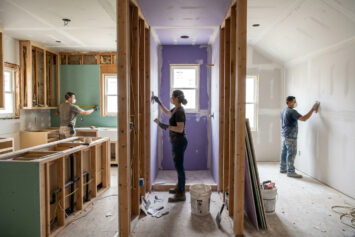
Two primary variables explain most of the per-room cost variation: the type of drywall required and how many precise cuts the installation involves. A bedroom with four flat walls, no cabinets, and two simple openings uses standard board and allows a crew to move efficiently. A bathroom of the same floor area has moisture-resistant board requirements, multiple fixture cutouts, and a precision tile backer zone at the tub or shower. Each cut takes time, and each material upgrade costs money.
Labor makes up 65 to 75 percent of the total installed cost of drywall. That means any factor that slows down the installation pace, including cut complexity, awkward access, specialty board handling, or ceiling height, has a proportionally large effect on the total price. A room where the crew can hang 10 sheets per hour costs significantly less than a room where they hang 5 because of outlet cutouts, cabinet soffits, and precise corner work.
The second major variable is the difference between floor area and wall surface area. Drywall is priced by wall and ceiling surface, not floor area. A 10-by-10-foot kitchen with 9-foot ceilings has 100 square feet of floor but approximately 460 square feet of wall and ceiling surface. When a quote comes in higher than you expected for a “small” room, the surface-area calculation almost always explains it.
Bedroom: The Baseline Room Type
How much does it cost to drywall a bedroom?
A bedroom is the simplest and most predictable drywall scope in a residential home. Four flat walls, a ceiling, one or two doors, and one or two windows. Standard 1/2-inch drywall throughout. No specialty board unless the bedroom shares a wall with a garage. Minimal fixture cutouts beyond a few electrical boxes.
A standard 12-by-12-foot bedroom with 8-foot ceilings has approximately 430 to 480 square feet of wall and ceiling surface area after subtracting for door and window openings. At 2026 installed rates of $1.50 to $3.50 per square foot for a Level 4 finish, the total cost range runs $580 to $1,800. Most mid-market bedrooms with straightforward framing and a skilled crew fall in the $820 to $1,200 range.
Bedrooms are the reference point for evaluating other room types. If a room costs more than a comparable bedroom, the premium is driven by material requirements, cut complexity, ceiling conditions, or some combination of all three. Every room discussed below costs more per square foot than a standard bedroom because of at least one of those factors.
Bathroom: Small Room, Higher Per-Square-Foot Rate
Why does a bathroom cost more per square foot to drywall than a bedroom?
Bathrooms produce the most consistent per-square-foot premium of any room type, despite often being the smallest rooms in the house. Three specific factors drive the cost up from the bedroom baseline.
First, material requirements. Bathrooms require moisture-resistant board throughout and cement board or foam backer in direct wet areas at the tub surround and shower enclosure. Moisture-resistant board runs 20 to 35 percent more per sheet than standard board. Cement board for shower areas runs $10 to $15 per sheet and is heavier and slower to cut. The material premium adds $40 to $100 to a typical bathroom scope before any labor is considered.
Second, cut complexity. A standard bathroom has a toilet, vanity, medicine cabinet, exhaust fan, light fixture, tub surround, and often a window. Each one requires a precise cutout in the drywall panel. A bathroom that would take 45 minutes to hang in a standard bedroom configuration takes two hours because of the number of cuts and the precision required around plumbing and fixtures.
Third, the minimum service fee effect. A small full bathroom of 50 to 80 square feet may involve the same setup time and crew cost as a room three times that size. The minimum service economics push the per-square-foot rate up significantly for small rooms.
Installed cost for a small bathroom (50 to 100 square feet of floor area) runs $400 to $650. A larger primary bathroom (100 to 150 square feet of floor area) runs $500 to $900. These figures assume moisture-resistant board throughout and cement backer at the wet zone, not standard drywall.
Kitchen: The Most Underestimated Room
Why does kitchen drywall cost more than most homeowners expect?
Kitchens combine two cost factors that rarely appear together: a large amount of wall surface area that is hidden by cabinets, and a high density of precise cutouts where visible wall is exposed. The cabinets cover significant wall area, but the wall behind them still needs to be drywalled because it exists and because cabinets mount to it. The cost of drywalling behind cabinets is not eliminated; it is just lower visibility than the area above them.
The visible areas in a kitchen, the backsplash zone, the soffit above upper cabinets, the area above the range hood, and the peninsula or island framing, involve a disproportionate number of cuts for the surface area involved. Electrical outlets are clustered in the backsplash zone. The range hood requires a precise duct penetration. Any soffit work involves non-standard angles and framing that slows installation pace.
Kitchens also often require moisture-resistant board in the sink and dishwasher splash zones, adding the same material premium as bathrooms in those specific areas without eliminating the standard board cost in the non-wet zones. The wall area behind base and upper cabinets typically receives standard board because it will never be exposed to moisture.
For a typical residential kitchen of 150 to 200 square feet of floor area, expect installed drywall costs of $800 to $1,800 depending on ceiling height, the amount of soffit work, and whether a tile backsplash or paint finish is planned. Kitchens with tall ceilings, complex soffits, or substantial visible wall area come in at the upper end of that range.
Living Room: Large Surface Area, Premium Finish
What drives drywall cost in a living room or open-plan space?
Living rooms are typically the largest single room in a home and often carry the highest finish-level expectation. A large living room of 16 by 20 feet with 9-foot ceilings has approximately 700 to 800 square feet of wall and ceiling surface area after openings. At standard rates, that scope runs $1,050 to $2,800 at Level 4 finish.
Living rooms benefit from economies of scale: a large, open room with few cutouts is efficient to hang, and the crew can move at a productive pace across straightforward surfaces. The cost per square foot in a living room is often lower than in a kitchen or bathroom because there are fewer complications per sheet installed.
Where living room costs rise above the baseline is in finish level. Living rooms are the highest-visibility space in most homes and the most likely location where a Level 5 smooth finish is specified rather than standard Level 4. A Level 5 upgrade adds $2 to $4 per square foot to the project cost for the skim coat labor. On a 700-square-foot living room scope, that premium adds $1,400 to $2,800 to the project, nearly doubling the cost of a standard finish in the same room.
Room-by-Room Cost Summary
| Room | Typical Floor Area | Approx. Wall + Ceiling Area | Estimated Installed Cost (Level 4) | Key Cost Driver |
|---|---|---|---|---|
| Standard bedroom | 144 sq ft (12×12) | 430 – 480 sq ft | $580 – $1,800 | Baseline; fewest complications |
| Primary bedroom | 200 – 250 sq ft | 600 – 750 sq ft | $850 – $2,600 | Larger surface area; often includes walk-in closet |
| Small bathroom | 50 – 100 sq ft | 200 – 350 sq ft | $400 – $650 | Moisture-resistant board; cut complexity; minimum service fee |
| Primary bathroom | 100 – 150 sq ft | 350 – 500 sq ft | $500 – $900 | Wet zone backer required; higher fixture density |
| Kitchen | 150 – 200 sq ft | 450 – 650 sq ft | $800 – $1,800 | Cut complexity; soffit work; moisture zone in splash area |
| Living room / open plan | 300 – 400 sq ft | 700 – 1,000 sq ft | $1,050 – $3,500 | Large surface area; often Level 5 finish required |
| Garage (2-car) | 400 – 500 sq ft | 800 – 1,200 sq ft | $1,000 – $3,900 | 5/8-inch Type X required on house-facing wall and ceiling; fire-rated assembly |
| Basement (1,000 sq ft floor) | 1,000 sq ft | 1,500 – 2,500 sq ft | $1,500 – $7,000 | Moisture-resistant board throughout; utility obstacles; irregular framing |
All figures reflect 2026 national averages for a standard Level 4 finish. High-cost urban markets run 25 to 40 percent above these ranges. Markets with lower labor costs may run 10 to 15 percent below. Specialty finish levels (Level 5 smooth) add $2 to $4 per square foot to any room scope.
How to Use This Information When Reviewing Quotes
How do room-specific costs help you evaluate a contractor’s bid?
When a quote comes in above or below the ranges above, the first question is always whether the contractor measured wall and ceiling area or floor area. A kitchen quoted at $400 for 150 square feet of floor area looks inexpensive. A kitchen quoted at $1,200 for 600 square feet of wall and ceiling area is exactly on market. They may be the same room described two different ways.
The second question is whether the specialty requirements were specified correctly. A bathroom quoted at the same per-square-foot rate as a bedroom almost certainly did not account for moisture-resistant board. A garage quote that does not mention Type X fire-rated board is not compliant with code. A living room quote with no finish level specification could be Level 3 priced as Level 4.
Most drywall pros who quote residential projects build the board type and finish level into their estimates without being asked. When a quote is missing these specifications, ask for them in writing before comparing it to other bids or accepting it as the basis for a contract.
Find a Drywall Contractor for Your Specific Room
Bathroom and kitchen work requires contractors who understand moisture management and specialty board requirements. Basement and garage work requires familiarity with fire-rated assemblies and below-grade moisture conditions. High-end living areas with Level 5 finish expectations require finishers with the skill to deliver a truly seamless result. The right contractor depends on the room.
DrywallProCenter.com connects homeowners with verified drywall professionals across the country. Search by zip code, compare contractor profiles and specialties, and request quotes from multiple pros in one place. Whether you are drywalling one room or multiple, finding the right contractor starts here.
Recent Drywall Articles
- Drywall Cost by Room: Kitchen, Bathroom, Bedroom Compared
 You are trying to budget for a renovation and you need a rough number for each room. The challenge is that drywall pricing is not consistent across room types. A … Read more
 - What Insurance Should My Drywall Contractor Have?You asked a contractor whether they are insured and they said yes. That answer, on its own, protects you almost not at all. There are multiple types of insurance a … Read more
- How to Get Multiple Drywall Bids and Actually Compare ThemYou have three quotes and the numbers are all over the place. One comes in at $1,900, one at $2,700, and one at $3,400. The instinct is to assume the … Read more
- What to Expect on Day One When Your Drywall Contractor ArrivesThe contractor is scheduled to arrive at 8 a.m. and you are not sure what is about to happen in your house. Will they start immediately or spend the morning … Read more
- Red Flags to Watch for When Hiring a Drywall ContractorYou have a few contractor quotes in hand and one of them is significantly cheaper than the others. Or a contractor showed up unsolicited after the storm last week and … Read more
- How to Read a Drywall Contractor’s Quote Without Getting BurnedYou have three quotes in hand and they are not close to each other. One comes in at $1,800, one at $2,600, and one at $3,100 for what appears to … Read more


This article was drafted with the assistance of AI and has been reviewed and edited by our editorial team for accuracy and quality.