

You have a contractor coming to give you a quote for a basement, a remodel, or a full new-construction finish. Before they arrive, you want to know what the numbers should look like. What does drywall installation actually cost per square foot in 2026, and what separates a reasonable bid from one that is too low or too high?
This breakdown covers everything that moves the per-square-foot price, with real 2026 figures, so you can evaluate quotes with confidence.
The 2026 Baseline: What Drywall Installation Costs Per Square Foot
The national average for professionally installed drywall runs $1.50 to $3.50 per square foot in 2026, covering materials, labor, hanging, taping, mudding, and sanding to a standard Level 4 finish. Most contractors use $2.20 to $2.65 per square foot as a realistic midpoint for quoting standard residential work.
That range sounds wide because it is. A straightforward new-construction bedroom with 8-foot ceilings and no obstacles lands near the low end. A remodel with high ceilings, specialty drywall, and a Level 5 finish can push well past the high end. The table below shows where common project types typically fall.
| Project Type | Typical Cost Per Sq Ft | Key Driver |
|---|---|---|
| New construction (open framing, 8-ft ceilings) | $1.50 – $3.00 | Accessible framing, no obstacles, efficient crew pace |
| Remodel or addition (existing structure) | $2.50 – $4.50 | Working around plumbing, electrical, and finished surfaces |
| Basement finishing | $1.75 – $3.50 | Irregular shapes, pipes, and wiring slow installation |
| Ceiling installation (standard height) | $2.00 – $3.80 | Overhead work is slower and more physically demanding |
| Vaulted or high ceilings | $3.00 – $5.00+ | Scaffolding or lifts required; complex cuts and angles |
| Bathroom or wet area (moisture-resistant board) | $2.00 – $4.00 | Specialty drywall material adds cost; more precise cuts |
Labor makes up roughly 70 percent of the total cost on most residential jobs. Regional labor rates drive price differences between markets more than material costs do. Urban markets in the Northeast and West Coast typically run 25 to 40 percent above national averages, while rural markets and labor-competitive metros like Houston or Dallas often stay near the low end of the national range.
How the Per-Square-Foot Price Breaks Down
What am I actually paying for within that price per square foot?
A complete installed price covers three distinct phases, each of which can also be quoted separately. Understanding what each phase costs helps you identify whether a quote is comprehensive or whether certain steps are being excluded.
| Phase | Cost Per Sq Ft | What It Includes |
|---|---|---|
| Hanging only (no finishing) | $0.85 – $1.90 | Measuring, cutting, and fastening panels to framing |
| Taping and mudding | $0.35 – $1.10 | Embedding tape at seams, applying joint compound coats |
| Sanding and finishing | Included in taping cost | Sanding between coats, final smooth surface prep |
| Texturing (add-on) | $0.80 – $2.00 | Orange peel, knockdown, skip trowel, or other surface textures |
| Old drywall removal | $0.50 – $2.50 | Tearing out and disposing of existing material in remodels |
When you receive a quote, confirm whether it covers all three phases together or whether taping and finishing are being billed as separate line items. Some contractors quote hanging-only prices that look low, then add finishing costs that bring the total closer to or above the full market range.
Finish Levels: The Biggest Variable Most Homeowners Overlook
How much does the finish level change the cost per square foot?
Drywall finishing is graded on a scale from Level 0 to Level 5. Most residential projects use Level 4, which includes embedded tape, two finish coats, and sanding. Level 5 adds a full skim coat over the entire surface and is appropriate for rooms where gloss or semi-gloss paint will be used, or wherever light hits walls at a sharp angle and surface imperfections would show.
The finish level can meaningfully change the cost of a job. A Level 5 finish adds $2.00 to $4.00 per square foot beyond the baseline hanging cost, because the skim coat requires significantly more labor and skill. On a 1,000-square-foot project, that is an additional $2,000 to $4,000 on top of the base installation price.
Most drywall pros recommend specifying the finish level in writing before any work begins. If a quote does not mention a finish level, ask directly what level is included and get the answer in the contract. A Level 3 finish bid and a Level 5 finish bid for the same room can differ by thousands of dollars, and the difference is not always obvious until the paint goes on and the results do not match expectations.
| Finish Level | Description | Typical Use | Add-On Cost vs. Level 4 |
|---|---|---|---|
| Level 3 | Tape plus one finish coat | Areas receiving heavy texture; not for flat paint | Less expensive than Level 4 |
| Level 4 | Tape plus two finish coats, sanded | Standard for most painted residential walls | Baseline |
| Level 5 | Full skim coat applied over Level 4 | High-gloss paint, critical lighting, feature walls | +$2.00 – $4.00 per sq ft |
Room-by-Room Cost Estimates
What does it cost to drywall specific rooms?
Per-square-foot rates are useful for budgeting at a project level, but most homeowners think in rooms. The estimates below reflect total wall and ceiling surface area, not floor area, at standard 8-foot ceiling heights and a Level 4 finish.
| Room | Approx. Wall + Ceiling Area | Estimated Installed Cost |
|---|---|---|
| Small bathroom | ~100 sq ft | $400 – $650 |
| 12 x 12 bedroom | ~500 sq ft | $580 – $1,800 |
| Large living room | ~700 sq ft | $1,500 – $3,000 |
| Basement (1,000 sq ft floor area) | ~1,500 – 2,000 sq ft | $2,250 – $7,000 |
| Whole house (2,000 sq ft) | ~5,000 – 7,000 sq ft | $8,000 – $30,000 |
These ranges reflect the full span of market conditions. A standard bedroom in a mid-cost market with straightforward framing lands in the middle of that range. The same bedroom in a high-cost market with complex angles or a premium finish level reaches the upper end.
What Pushes a Bid Above the Standard Range
Why would a quote come in higher than the national average?
Several factors legitimately increase the per-square-foot price. None of them are red flags on their own. They are simply variables that add time or material cost to the job.
- Ceiling height above 8 feet: Vaulted, cathedral, and high ceilings require scaffolding or lifts, more complex cuts, and more labor time working overhead. Expect a meaningful premium above standard wall rates.
- Specialty drywall types: Moisture-resistant board (used in bathrooms, basements, and kitchens) and fire-rated drywall (required in garages and some shared walls) cost more per sheet and are slightly more difficult to work with.
- Complex room geometry: Curved walls, multiple corners, arches, and built-in features increase both material waste and labor time. Complex layouts can add 10 to 20 percent above a standard-room quote.
- Remodel vs. new construction: Contractors working inside existing structures must cut around electrical boxes, plumbing runs, and existing finishes. That added precision and cleanup time is reflected in the higher remodel price range.
- High-cost labor markets: In cities like New York, San Francisco, and Boston, labor rates can push total installed costs to $4.00 per square foot or more on standard work.
- Seasonal demand: Spring and summer are peak construction seasons. Contractors often charge premium rates when their schedules are full. Scheduling your project in the fall or winter can bring bids down by 5 to 15 percent in many markets.
New Construction vs. Remodel: A Meaningful Price Difference
Why does a remodel cost more per square foot than new construction?
In new construction, framing is open, walls are empty, and a crew can move efficiently. A four-person crew can hang 45 to 80 sheets per day under these conditions. That efficiency is reflected in lower per-square-foot costs, typically $1.50 to $3.00 for new construction work.
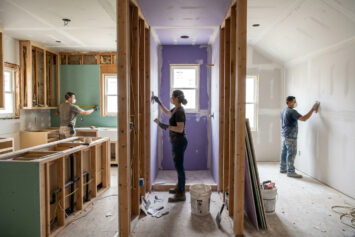
In a remodel, the same crew works more slowly. They are cutting around junction boxes, fitting panels near plumbing stubs, protecting existing floors and trim, and often handling smaller sections rather than full sheets. Remodeling projects consistently run $2.50 to $4.50 per square foot because of that added time and complexity, even when the labor rate itself has not changed.
For a 1,500-square-foot remodel, the difference between new-construction and remodel pricing can add $1,500 to $2,250 to the total job cost. That is not a contractor charging more for the same work. It is a reflection of genuinely different working conditions.
When Should You Hire a Specialist Rather Than a Handyman?
For small patching jobs or minor repairs, a handyman can often handle the work competently and at a lower minimum rate. For any full-room or whole-house installation, a specialist drywall contractor is almost always the better choice.
Hire a dedicated drywall contractor when:
- The project covers more than one room or involves ceilings
- Specialty board is required, including moisture-resistant or fire-rated panels
- You are specifying a Level 4 or Level 5 finish, where finishing quality directly affects how the painted room looks
- The project involves vaulted or high ceilings, which require equipment and technique a generalist may not carry
- You are finishing a basement, where irregular framing and utility obstacles require experience to navigate efficiently
- The job is part of a larger remodel where permit inspections will cover the drywall work
Most drywall pros note that the most common callbacks they receive come from jobs where a handyman handled a larger installation and the finish quality did not hold up once paint was applied. The difference between a Level 4 finish done correctly and one done without enough coats or sanding is visible the moment the light hits the wall.
Find a Vetted Drywall Contractor Near You
Getting a fair price starts with getting quotes from contractors who know what they are doing. A contractor who can explain their finish level, itemize their quote, and confirm the scope in writing is one worth working with.
DrywallProCenter.com connects homeowners with verified drywall professionals across the country. Search by zip code, compare profiles and reviews, and request quotes from multiple contractors in one place. Whether you are drywalling one room or an entire home, finding the right pro starts here.
Recent Drywall Articles
- Drywall Cost by Room: Kitchen, Bathroom, Bedroom Compared
 You are trying to budget for a renovation and you need a rough number for each room. The challenge is that drywall pricing is not consistent across room types. A … Read more
 - What Insurance Should My Drywall Contractor Have?You asked a contractor whether they are insured and they said yes. That answer, on its own, protects you almost not at all. There are multiple types of insurance a … Read more
- How to Get Multiple Drywall Bids and Actually Compare ThemYou have three quotes and the numbers are all over the place. One comes in at $1,900, one at $2,700, and one at $3,400. The instinct is to assume the … Read more
- What to Expect on Day One When Your Drywall Contractor ArrivesThe contractor is scheduled to arrive at 8 a.m. and you are not sure what is about to happen in your house. Will they start immediately or spend the morning … Read more
- Red Flags to Watch for When Hiring a Drywall ContractorYou have a few contractor quotes in hand and one of them is significantly cheaper than the others. Or a contractor showed up unsolicited after the storm last week and … Read more
- How to Read a Drywall Contractor’s Quote Without Getting BurnedYou have three quotes in hand and they are not close to each other. One comes in at $1,800, one at $2,600, and one at $3,100 for what appears to … Read more


This article was drafted with the assistance of AI and has been reviewed and edited by our editorial team for accuracy and quality.